
Home > Domestic & International News > Domestic News > 6.15% and RM79.6 Billion: What the Latest EPF Dividend Really Indicates
Share
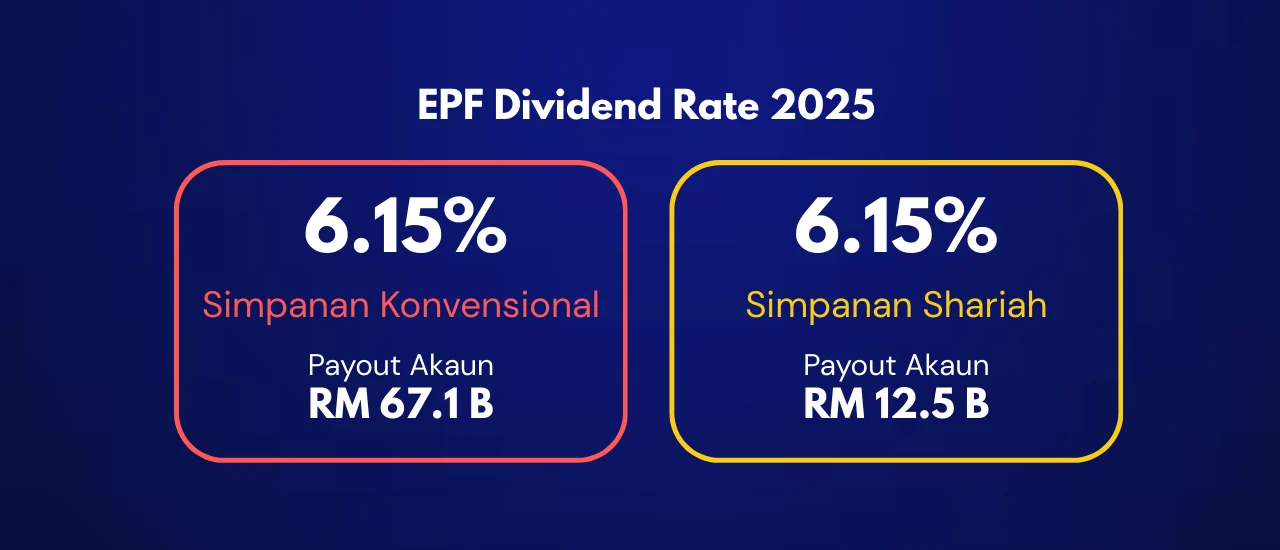
The Employees Provident Fund (EPF) recently announced a 6.15% dividend for 2025, compared to 6.30% in 2024. Public discussion has largely focused on the 0.15 percentage-point decline. However, a broader review of the data suggests that the overall position of the fund remains robust.
While year-on-year comparisons are common, dividend performance should be assessed within the context of long-term sustainability, total payouts, and retirement adequacy.
Total Distribution and Fund Growth
According to public statements by Amir Hamzah Azizan, total dividend payouts increased by 8.7% to RM79.6 billion. The fund’s size expanded to RM1.409 trillion.
Although the dividend rate moderated slightly, the aggregate amount distributed to members rose. In addition, the 6.15% dividend remains above EPF’s 5-year, 10-year and 20-year historical averages.
These indicators suggest that the fund continues to operate within a stable performance range rather than reflecting structural weakness.
Investment Mandate and Risk Discipline
EPF operates under a statutory framework that guarantees a minimum dividend of 2.5% for the Conventional account. Returns above this threshold are generated through diversified investment strategies across asset classes and geographies.
In a year marked by softer global equity markets and currency adjustments, delivering a return above 6% reflects adherence to a disciplined risk-management approach. Retirement funds typically prioritise capital preservation and sustainable growth over short-term outperformance.
The objective is not to maximise returns in a single year, but to generate consistent outcomes across economic cycles.
Long-Term Returns and Compounding
Comparisons between EPF dividends and short-term bank fixed deposit (FD) rates are frequently made in public discourse. However, the two instruments serve different purposes.
FDs are short-tenure savings tools, whereas EPF is structured as a compulsory, long-term retirement scheme. The impact of compounding over 20 to 30 years significantly outweighs marginal annual fluctuations.
A consistent return in the range of 6% over extended periods materially enhances retirement accumulation. From a long-term planning perspective, stability and sustainability are more critical than incremental annual variations.
Retirement Adequacy Indicators
Beyond the dividend rate itself, member data presents encouraging trends.
For the first time, over 41% of active members have surpassed the Basic Savings threshold of RM240,000. Voluntary contributions reached RM19.2 billion, with close to one million individuals contributing above mandatory levels.
These developments indicate growing awareness of retirement preparedness among Malaysians, including participation from the informal sector. Increased voluntary contributions reflect improved financial planning behaviour rather than reliance solely on statutory requirements.
In evaluating EPF’s performance, such structural indicators may be more meaningful than isolated annual percentage changes.
Liquidity Considerations and Policy Balance
Recent policy discussions have included proposals to increase flexibility within EPF accounts or to facilitate additional withdrawals. While such measures may provide short-term financial relief, they must be evaluated against long-term retirement sustainability.
Withdrawals reduce both principal and future compounded growth. Over time, repeated access to retirement funds can materially affect adequacy at retirement age.
The core function of EPF remains the protection and accumulation of retirement savings. Balancing liquidity needs with long-term financial security requires careful policy calibration.
Conclusion
The 6.15% dividend should be viewed within a broader framework of fund growth, total payout expansion, long-term averages, and member retirement readiness.
Although the rate declined marginally from the previous year, overall distributions increased, fund assets expanded, and more members achieved meaningful savings thresholds. These indicators point toward systemic stability rather than deterioration.
As noted by the Finance Minister, EPF’s mandate is not to ensure year-on-year dividend increases, but to safeguard retirement savings responsibly across varying market conditions.
In assessing retirement systems, sustainability, discipline, and adequacy remain the primary benchmarks. From that perspective, the latest performance reflects continuity in mandate and execution rather than deviation.



Privacy Settings
We use cookies to improve your browsing experience, to provide personalised ads or content and to analyse our traffic. If you click on "Accept All", you agree to the use of cookies.
Cookie Usage
We use cookies to help you navigate our site smoothly and to support key functions. “Necessary” cookies are always active as they enable basic features. We also use third-party cookies to analyse usage, remember your preferences, and deliver relevant content. These cookies will only be stored with your consent. You may enable or disable them at any time, but doing so could impact your browsing experience.